Tuesday, August 31, 2010

New Sandals Rubbing You the Wrong Way?

As you know, I come from coastal Southern California.  I wear sandals rain or shine (unless it's really cold) with shorts, pants and dresses.  I require a decent paycheck before I'm willing to wear shoes.  I go through a mediocre quality pair of sandals in about six to eight months.  This time, I decided to spend a good deal more money on my yearly pair of sandals in hopes that it will at least actually last the entire year, maybe more.  They are leather and beautiful.  The problem with new leather sandals is that the straps will likely gnaw on your feet until they are well broken-in.  Within a few miles, the tops of my feet were pretty well nibbled.

So how does one deal with this situation?  There are two basic things.  First, you need to break in new leather sandals as quickly as possible.  Second, you need to protect your feet while doing it.

The first thing is accomplished by applying some kind of oil or butter to the leather to help it soften and then wearing them as much as possible.  I applied a bit of some homemade chapstick (beeswax and coco butter) to the underside of the straps.  Tip:  Do no apply it directly.  Use your finger unless you want to be kissing sandals from now on.  Then walk, walk, walk.

During that walking period, you must put some layer of something between your feet and the straps.  You can use band-aids but they are a bit pricey.  Liquid bandage is nice if you are going somewhere nice and you don't want "bandage foot".  It goes on clear but getting it off is a bit of a task.  If you don't remove it properly, it looks like your feet are shedding their skin.  My solution?  Masking tape.  Cheap and easy.  Apply two strips of masking tape to the top of each foot where the straps rub.

So why buy expensive leather sandals if they do this to your feet?  First, they last way longer.  Second, they mold to your feet over time, so they start to fit like custom sandals.  Third, they are more likely to be built with sturdy soles.  I bought mine for this reason.  The last pair of leathers I bought had the same cheap bottoms like any other sandals.  You get what you pay for.  They were about to wear through completely when I came across these new ones.

Awesome Tip of the Day:  Wearing shoes and socks creates a sweaty environment for bacteria and fungi to grow, which makes them and your feet stink.  When you wear sandals, your feet are constantly exposed to fresh air.  You can wear sandals all day and never have the stinky feet problem unless you're trekking through filthy territory.  Then you need to wash.  Speaking of which, sandals are also good for the rain.  They allow your feet to dry quickly so you don't get stuck with cold squishy shoes all day.

Sunday, August 29, 2010

Two Egg Taco | Recipe

(Click here for more cooking ideas.)

Today's post is a quick recipe for a very small meal for when you're on the go but need to have something healthy in a hurry.

Two Egg Taco

5-10 minutes, serves one.

2 eggs
1 corn tortilla
1 small tomato, cubed (or a few cherry tomatoes)
A few leaves of baby spinach or fresh basil

Scramble the eggs in a small frying pan with the tomato and spinach over a medium heat.  If you are using a non-stick pan, you do not need any oil or butter to scramble eggs.  The juice from the tomato may make the eggs slightly runnier, so feel free to cook them a little longer than usual.  The spinach leaves will shrivel as they heat up.  If you are worried about cholesterol, omit one or both of the egg yolks.

Awesome Tip if the Day:  Some people like to beat the eggs in a separate container first.  I see no need.  I dump the eggs straight in to the pan and break the yolks with my spatula.  I then mix the eggs during the cooking process of folding and turning.  I find this gives a nice texture and flavor variant.  Plus, it's less work and dirty dishes.  Just make sure you get the yolks distributed evenly.

Remove the pan from the fire and turn down the heat to low.  Place your corn tortilla over the fire for about 20 seconds, then flip.  I do this with my hands by grabbing just the edge.  If you can't do this, it's a good indication that the fire is on too high.  If you're still worried about burning yourself, feel free to use tongs.  The tortilla is ready when it is hot and slightly crispy but not burnt.  Remove from heat.  Scoop the egg mix onto the tortilla and fold it in half.  Eat hot.

If you like your vegetables fresh, scramble the eggs alone and add them uncooked to the finished product.

Substitutes.  Mushrooms, onions, and bell peppers are also great in this meal.  Make sure you saute your onions for a minute before adding the eggs if you choose to use them.

Long Distance Relationships in a Nutshell

If you are planning on having a long distance relationhship, here are some things you should think about and plan for before you start.

The main and most obvious thing is that you will be alone.  Technology has changed what that means for the most part, but either way, there will be plenty of times that you will simply not be able to contact your significant other.  Period.  You will not be able to hold that person at all.  You will not be able to do the simple things together that you would otherwise take for granted.  I suspect that people struggle with that basically in one of two ways depending on personality type in regards to level of independence.  Other factors are how important physical affection is to you, the length of time you will be apart, and how much and what type of contact you will have.  Since all of these factors are important, I will examine them in combination.

1.  Business trip.  A few days to a month is what I call "business trip".  Wether or not you have a lot of contact, this is not the end of the world.  If you are co-dependent, this can still be very difficult because a month can feel like a long time when you're lonely.  If you are used to doing everything together and being together all the time, I strongly suggest spending a lot of time with your friends and family while your significant other is away.  If you are the one going away, I strongly suggest focusing on the reason you are leaving.  If you have time, go see local attractions and take a lot of pictures to show to the person you left at home.  This helps you deal with the inevitable thinking about your partner in a constructive way, and gives you something to share when you get home.

If you are a more independent person, you should not have all that difficult a time with this length of separation.  Consider it a vacation for catching up on some "me time".

2.  Short term.  Up to about six months I would consider short term.  This can be a trying time for co-dependent people because there is enough time to really feel lonely and continue feeling lonely.  The best thing I can offer you is to come up with a project that will take the about amount of time your partner will be gone to complete.  You can use that time specifically to be with that person in spirit and do something constructive or creative while they are gone.  Having spent a little time "with your partner" in this way, it will be easier for you to go about your day and focus on other things.  Counting down the days until they come back should be saved until you are no more than a month away or you will drive yourself crazy.  Instead, think about all of the things you have to do until they return.  That will help you stay busy and avoid depression.  You should also use this time to watch certain movies, eat certain foods, attend certain functions or do certain hobbies by yourself or with friends that your significant other does not enjoy.

If you are independent, this can be a trying time because you probably deal with separation by moving on.  It can by psychologically very difficult to get your mind around being alone but not being single.  You may find it helpful to think about your next appointment with your significant other so that you have something to look forward to together.  I suggest making plans for that time to keep your mind on being a couple.  They will go away and come back.  When they do, you can do all of those things you want to do.  If you are the one going away, this is an exercise in consideration.  Keep your partner on the backburner while you do your things.  Pick them up a souvenir.  Write a thoughtful email.  Send a picture.  These things keep you both in a "couple" mindset while you're apart.

3.  Long term.  Up to about a year to a year and a half is long term.  I honestly do not recommend this length of separation, but it's doable if you're really committed.  If you are co-dependent, my honest suggestion is that you become more independent if you wish for your relationship to survive the separation.  If it does work out, hopefully both you and your relationship will be stronger because of it.  You will have learned to be self-sufficient in the absense of your partner and that will help you in life either way.

For independent people, this can be difficult time because moving on starts to look more and more attractive.  It is up to choice wether you go this route.  Please remember that it will take some serious dedication on your part.  If you do not plan to marry this person, I would really factor that in to my decision.  If you are married, hang in there.  You already made your promise.  Keep them in your thoughts.  When you do miss them, just do something you enjoyed doing together when you were in the same place.

4.  Indefinite.  After about two years, I start to call it indefinite.  That's because anything can happen in those two years that turns it into to four years.  If you do not plan to marry, I really suggest letting the whole thing go.  It may sound unromantic of me, but you will find someone else.  If you are that committed, then I suggest finding some way to either follow your partner or have them follow you within six months to a year.  If not, move on.  Being apart that long is just really impractical because you remain in limbo of being alone but not single for way beyond what is reasonable.  It just doesn't make sense.  If you choose to just be friends until you can be together again, that's up to you.  Sometimes it works and sometimes it doesn't, but at least you aren't bound by commitment while you wait.

Other Factors

Faithfulness.  This is actually really simple.  First, accept that regardless of level of commitment in a relationship, there will always be other attractive people out there that you can be just as attracted to.  Having a little crush on someone does not mean that you no longer love the person you're with.  It is a common passing emotion provided you let it pass.  You know pretty quickly when you have a crush on someone.  The most important thing is that you do not feed it.  If that means you have to stay away from that person until the emotion goes away, fine.  Do not hang out with them.  Do not fantasize about them.  Do not flirt with them.  It's a slippery slope as that is how things would naturally develop into something more if you were single.  If you tend to view it as "resisting temptation", that just makes it more tempting.  It's also important to remember that the other person may not be as attractive as they seem.  It may be just misplaced loneliness or it may be that you're only seeing the attractive qualities.  You may be missing the not attractive traits that you would surely find if you knew that person as well as you know your partner.

On the other side, do not try to get other people to be attracted to you, either.  I understand that this is a difficult thing to address, because people who habitually do this are usually not that honest with themselves about it.  It may backfire and I really suggest staying away from such a practice in life.

Communication.  If it is available, I suggest regular visits on Skype by appointment.  It's free  for computer to computer video calls and easy to use.  MSN Messenger also has a free videophone service.  They both drop calls or freeze sometimes depending on traffic and internet service quality.  Seeing and hearing your partner in real time makes separation much more bearable by providing some "couple time".  It's best to have appointments so that you are neither smothering nor neglecting eachother.  You also avoid trying to contact one another while you are busy.  Being rushed off the phone or simply not answered can play tricks on your mind when you've been apart long enough, so a regular appointment is best.  Make that phone call a priority.  It's highly inconsiderate to leave the other person hanging, just wondering.  At the same time, if for some reason the other person cannot make it, try to be understanding in that they also have a life to attend.

My parents have Skype dinner dates with a glass of wine when they have to be apart.  I find this practice both adorable and wonderful.  It helps maintain the routine of having a meal together while being somewhat romantic.

Jealousy.  There is no room for jealousy in a long distance relationship.  If you are a jealous person, I suggest either dealing with that issue now, or abandoning the whole thing.  Jealousy is a sign of possesiveness and distrust.  If it is simply possesiveness, then you will not be able to handle a relationship in which the person is not with you.  I foresee a painful breakup.  If it is distrust, then you need to be honest with yourself about why.  If you can see that you are having an irrational emotional response to the fact that your partner is attractive and wandering around without you, there is hope for you.  If you truly believe that your partner is not trustworthy, you should not be with that person at all, at home or long distance.  Lack of trust is a serious thing.  Wether or not that person is truly untrustworthy is irrelevant.  Either way, you will not be happy.  There is simply no reason to be with someone when you're not happy.

Something to Carry.  For any personality type or distance apart, it is a good idea to have an object with you that belongs to or reminds you of the other person.  This helps you in times of loneliness.  Pictures of both of you doing a favorite activity or from right before the separation are nice.  Letters are nice.  A special keepsake is appropriate.  A favorite something or other that you don't mind giving up for the other person to carry with them until they come back is perfect.  Make sure it goes in the carry on in case the airline loses your luggage.

Light at the End of the Tunnel.  Nobody likes uncertainty in a committed relationship.  Try to establish a next time that you will actually be together in person.  Even if it's really far away, it helps emotionally to at least know when that time will be.  Wandering through life without a goal is not very motivating and wandering through a relationship in such a way can be similarly disappointing.

Arguments.  It is more important than ever to play fair when you argue at a distance.  If you have a problem with your temper, it will really backfire when you know that you cannot contact that person again unless they feel like answering.  Choose your words carefully.  Now is a good time to learn to apologize if it is difficult for you.  Also, make sure you are actually getting through whatever issue it is or it's not worth arguing over.  You can no longer cover up conflicts half way through with "make up sex".  If you use conflict as a way to control the other person or to get make up sex, it will all backfire at a distance.  Think about it thoroughly before you get mad and start saying anything that doesn't need to be said.

Physical Contact.  If your relationship is largely based on physical presense and contact, you are unlikely to be successful in a long distance relationship.  This sounds obvious but many people don't think about it.

Ability to Care for Oneself.  This is necessary.  Not only do you need to be able to care for yourself, but you need to trust your partner to care for themself as well.  If you have a need to baby that person and take care of them and worry about them, etc., you are going to need to let that go.  You may struggle with the idea of not being needed, but hopefully you will come to understand that your partner is with you because they love you, not because they need you.  You will probably also gain a new respect for that person as you see them coping with life on their own.

It is important to mention that long distance relationships are simply not for everyone.  You must be very honest with yourself and your partner about how you really feel.  If you are already having problems in your relationship, being long distance is probably going to bring those things out.  Aside from that, I say good luck.

My husband and I have been long distance three times now since we were engaged.  The first time was really difficult because I wasn't quite sure how things would be when we saw eachother again.  The first time we reunited, all of my uncertainties were calmed.  What was most important to me was that he was faithful and that we still had our spark.  I had been with multiple cheaters before, so I could easily feel the difference.  I could feel in his presence when we met at the airport that everything had gone well and that everything would be okay.  Armed with that knowledge, being apart has gotten much easier.  I no longer worry like I did the first time because I know that everything will be fine when we're together again.  It may not be too pleasant, but it's not too painful either.  We also allow eachother to change independently and apreciate those little changes in lifestyle and maturity (within reasonable boundaries).  That mutual respect and allowance for freedom helps us enjoy our time apart as well as our time together.  Point being, if you are planning to be apart on a somewhat regular basis, be aware that the first time is the most difficult and that it will get easier.

Awsomesome Tip of the Day:  Don't panic.

Thursday, August 26, 2010

Arnica Montana for Joint Pain Relief in Dogs

My dog has old joint injuries (thanks to squirrel holes) and arthritis due to age and size.  A regular low dose of arnica montana in her food and regular, mild exercise has kept her walking and playing at the beach for the last three years.  I originally was recommended these tiny pills to treat my mom's arthritis, but I was desperate one day to treat my dog when she had a bad sprain.  She has never displayed any visible side effects and appears to be much happier and active when she is receiving her 30X treatment.

If your dog has arthritis, I suggest further researching the use of arnica in treating inflammation.  A regular low dose could reduce pain and inflammation and improve the quality of your dog's life.  They don't live very long, but the years they do have are best spent active and happy.

How to Get Beach Tar Off Your Feet

If you are from or have visited coastal California, chances are you have experienced tar on the feet.  If you don't know what I'm talking about, it's a black, sticky goo that is the result of natural petroleum seepage.  In fact, tar is so common here that the famous Pismo Beach is actually named after tar in the native Chumash language.  Depending on the area and the tide, a walk on the beach can get you anything from a few spots of tar on your feet to essentially a new pair of sandals.

There are three things to remember when visiting a beach that is littered with tar.  The first is that you should not wear shoes.  This sounds counter intuitive, but it is much easier to get it off your feet than your shoes.  Also, it will show that you are clearly a tourist, because no local of any beach town will every wear shoes at the beach unless they're going for a run (maybe).  The second thing is that you are better off planning for getting tar on your feet before you leave the house, just in case.  The third is that NO amount of soap and water will effectively remove tar.

So what does?  Tar is most easily removed by scraping off the excess on a nearby rock or curb and then dissolving the rest with oil and a paper towel or cloth.  Any cheap oil will do.  Baby oil is great if you have it laying around.  Canola oil works beautifully.  I would avoid using anything else that is more expensive or actually good for cooking because you may need to use a lot of it.  Simply drip a spot of oil on a paper towel (maybe a teaspoon if you only have a few spots) and polish the bottom of your feet until the tar is removed.  It is best to fold up the paper towel first so you can refold it in another direction and use both sides.  It will still be effective and it will reduce waste.  Once the tar is removed, dry your feet off with a clean paper towel or wash your feet with soap and water so as not to slip or leave oil stains on your patio, which are difficult to remove.

There are products sold specifically for removing tar and they honestly work no better than simple cooking or baby oil.  Plus, they are expensive.  It is best to leave oil and paper towels or an old T-shirt in your car or outside your house so that you can remove the tar before tracking it everywhere.  Oil will also work on hair and flooring.  It may save clothing and carpet, but I wouldn't count on it.

Awesome Tip of the Day:  So why not wear shoes?  Because shoes are expensive and feet come standard. ;)  The skin on your feet is constantly growing and shedding.  Even if you did nothing to remove the tar from your feet, it would eventually come off.  Your shoes, however, do not change.  Once tar is in there, it's in there.  The oil trick may work on your shoes but it may still stain an ugly brownish black color and the oil itself can be corrosive to the rubber soles, causing accelerated wear.  Walking barefoot is good for you anyway.  Just watch where you walk.

If a bottle of oil is not available, you can always use grass and sand.  The juicy plants like grass and other plants commonly found near the beach are pretty good in a pinch.  From standing, remove tar from one foot at a time by pressing your foot against the grass in a twisting motion.  A round tuft of grass fits foot arches quite well.  Once the majority of tar is removed, a quick sanding will get rid of the rest.  Voila!  Clean feet.  The photo at the top of this post was taken after a quick rub in the grass.  As you can see, there isn't much left.

While you are visiting our beaches, please remember to pick up after your dog and do not leave cigarette butts, bottle caps, or other trash behind.  Such pollution can leave our local surfers and other wild life sick or injured.  We take our beaches very seriously, but we are usually friendly and will kindly welcome back respectful visitors.

Sunday, August 22, 2010

How to Heal New Piercings Quickly

Here's a trick that I learned with the experience of piercing the cartilage in my ear.  The first time I did this, I did it all wrong.  I followed the advice of the inexperienced piercer.  She gave me a barbel and a bottle of antiseptic.  She said the bar would be good because the rings get caught on everything.  Wrong, wrong, wrong.  The second time, I came up with my own treatment plan and went to an intelligent piercer.  She put in a captive bead ring, which never got caught on anything, ever.  The barbell I had on the previous one got caught on everything, got infected, left a big keloid for several months, never quite healed right, and eventually got ripped out.  It was better that way because that led me to get a new one that healed up beautifully and I've had it for years with no problems.

Awesome Tip of the Day:  If you do pierce cartilage, make sure your piercer is using a hollow needle that is one gauge thicker than the jewelry you intend to use.  This is so that there will be space for the skin to grow between the hole in the cartilage and the jewelry.  Also, this will help take some of the friction and pressure off of a new piercing while it's still a little swollen.

To get to the point, new piercings need air, cleanliness, and lubrication.  Most people only give them cleanliness and maybe air.  It is important that any new piercing be closed with some kind of ring or if that's not possible because of the type of piercing, a longer bar so that there is space to move or turn it for cleaning purposes.

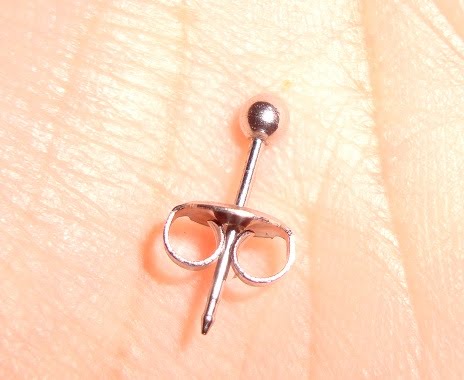
If you are simply getting your ears pierced with a piercing gun, ignore what the piercer said about not taking it out until it's healed.  Buy a 20 gauge captive bead ring.  Sanitize it with rubbing alcohol and then lubricate it.  Remove the earring you were pierced with and replace it with the captive bead ring.  This gauge does not require any tools to put in and it is right about the size of what is already in your ear.

The reason you do this is that the earring you were pierced with was really only meant to be easy to use for the piercer, but not actually good for the healing process.  As mentioned above, the jewelry needs to provide space for cleaning and a flow of fresh air.  The short bar length and wide backing prevent both of these things.  The bar is also sharp on the end since it is used like a needle, which can be uncomfortable behind your ear, especially when you sleep.  A captive bead ring is easy to insert and able to be turned, which is very convenient for cleaning.

For cleanliness, the good piercers that I have known recommend plain liquid Dial soap.  Really, any plain liquid antibacterial soap is good.  Look for one with minimal dyes and perfumes.  Simply water and soap up the captive bead ring and rotate it through the piercing.  Rinse thoroughly with clean water and continue rotating until all the soap is gone and the ring is clean.  Do this step twice a day or as needed.

Lubrication is the thing that most people don't seem to think about but it's very important to speed up the healing process.  Take a dab of any kind of thin, clean, edible oil and rub it on your freshly cleaned ring, being sure to rotate it through so that the whole ring and the inside of the piercing are all sufficiently lubricated.  I used coconut oil, but my friend used olive oil for hers.  The reason for this is that a new piercing needs constant lubrication because new piercings are sticky.  Your body is trying to grow new skin cells in the area that was punctured with the added irritation of a metal device (which should only be surgical stainless steel).  When your skin gets stuck to the ring, it is painful to turn because you are essentially tearing at the area that is trying to heal.  This makes for a greater potential for scarring and just makes the healing process longer and painful.  A little oil solves that problem.

Just to mention, if your piercing is anywhere on your head, it is a good idea to keep your hair out of the way for awhile to prevent contamination and pulling.

I used this method for myself and recommended it to all my friends when they got new piercings.  They all reported positive results.  This is also a good method to encourage an already infected piercing to actually heal.  However, if it becomes very painful and inflamed, you will probably have to squeeze puss out of it.  Do not let it get to this point.  If it does, you may have to go to a doctor and you may have to take it out.

Saturday, August 21, 2010

The Secret to Healthy, Beautiful Hair

Well, there is more than one and they're not exactly secrets, but it seems like a lot of people really have no idea what to do, or not do, with their hair.  First, genetics plays a certain role.  Not everyone can have a five inch ponytail circumference.  Everyone has a predetermined length that is their maximum hair length before it falls out, takes a break, and grows again.  That aside, anyone who has hair can have beautiful, healthy hair by simply understanding what their hair does and does not need.

I'm writing this article under the assumption that people (male and female, young and old) want thicker (both in volume and individual strands), shinier, and overall healthier hair.  Just like a dog's coat, the condition of our hair is a direct indication of our our health.  Healthy is beautiful.  I'm also assuming the understanding that everyone has a genetically predetermined maximum potential in every category of their lives, and that the goal is to reach that potential.  It is a good strategy for life is to at least improve our weakest points so that they are at a personally acceptable level, and then play our strong points to our maximum potential.  Whatever your goal is with your hair, this should help you get there.


Hair Needs

1. Nutrition.  This is key to anything relating to your body.  If your diet is lacking in the essential proteins, fatty acids, vitamins and minerals that it needs to optimally function, than you will be robbing yourself of your full potential across the board.  Healthy hair starts with eating right.  If you not receiving what you need from your diet alone, than it is a good idea to supplement with a good quality regular vitamin that contains whatever it is that you're lacking.  Give your body the right building blocks to grow healthy hair.  Also, give your body water or at least liquid.  You need it.

2. Circulation.  Without this, nutrition is useless.  Your body brings nutrients to all areas of the body through your blood stream.  Staying active can actually improve your hair growth and condition.  For those of you who have a hard time staying active due to physical impairments or if you just want a little extra boost for your scalp, give yourself a scalp massage daily.  This not only feels wonderful, but helps circulate the blood through the scalp, which can lead to healthier growth.  I personally advocate gentle traction as well.  Grab a handful of hair close to your scalp and pull gently.  Hold for a few seconds and move on to a different area.  I do a little massage and traction when I lay down in bed most nights.  It helps me get to sleep and it helped thicken up that area on top of my head that was thinning for some reason.

3. Moisture.  It's not a good plan to shampoo and not use conditioner or at least oil.  However, I've met a few (mostly men) who just didn't really think about that.  Hair likes to stay moist.  Your hair, like driftwood, does not enjoy being soaked, then dried, then soaked, then dried...  By dried, I mean over dried.  We'll get more into that further down.


Hair Care Basics

1. Washing.  Washing is a big subject.  You really should only wash your hair as often as it needs it.  It is important to note that shampoo strips your hair of it's natural oils.  For me, this was the cause of relentless frizzy hair.  Most shampoos contain sodium laurel/laureth sulphate, which is a fairly harsh detergent.  Their are some milder shampoos that contain similar but slightly gentler detergents.  If you are one who likes to shampoo daily, you are probably better off switching to a gentler shampoo.  You should definitely change your shampooing to shampooing only the scalp area.  The rest does not really need shampoo, believe it or not.

You also might want to reconsider whether shampoo is really that important at all.  An interesting thing that many people don't know, is that conditioner alone gets your hair and scalp very clean without drying it out.  The oils and creams in conditioners actually do a much better job of dissolving the oil (sebum) from your scalp without stripping it.  I didn't believe this for a long time and then finally tried it.  I will never go back.

To do a conditioner only wash, apply the conditioner to your scalp area and scrub it into your scalp just as you would a shampoo.  You can work it down your length or add more depending on how long your hair is.  Let it sit while you soap off the rest of your body and then rinse thoroughly.  If you have a particularly oily scalp, you can do a second application.  I do this if I skip a wash day or if I sweat excessively.

There are those who wash their hair with water only and are really happy about it.  I don't know much about this honestly because I've never done it.

It is important to note that most conditioners contain silicones, especially the ones that came to be "moisturizing".  What is really happening is that they silicones in the conditioner (and sometimes shampoo) coat your hair so that it smooths it out and gives it a slippery texture.  This makes it appear moisturized and makes it much easier for many people to detangle their hair.  Some types of silicone are water soluble and are of little danger to your hair.  Others are not, and require being stripped from your hair by a heavy shampooing.  These types of silicone tend to dry out your hair because they do not allow water to pass through and they also require repetitive shampooing.  When these types of silicones buildup on your hair, they can cause your hair appear dull and have a rough texture.  If you want to wash your hair with conditioner only, such a conditioner is not recommended.  You can identify a silicone ingredient by checking the labels on your shampoo and conditioner bottles for any ingredient that ends in -cone.  Dimenthicone is probably the most common.  The best part about silicone free conditioner is that it's usually cheaper.  Speaking of awesome...

Awesome Tip of the Day:  Is your scalp too oily?  Over use of shampoo may be the culprit.  By constantly stripping your hair and scalp dry, your scalp reacts by overproducing sebum.  You can reverse this process by switching to a milder shampoo and/or slowly stretching washes to every other day or longer.  Conditioner only washes also work.  It may take a month for your scalp to readjust, during which your hair and scalp will probably be oilier than you like.  Just wear it up when it gets oily and wait it out.

2.  Drying.  It is always best to let your hair air dry naturally whenever possible.  Heat damage is one of the worst things you can do to your hair, second only to chemical damage.  Heat damage can cause breakage and frizziness.  If you must blow dry, use a cool setting.  You will see great improvement in your new growth if you simply give up the blow dryer.  If you need your hair to be dried a little faster, you can actually use your hands to dry it.  To do this, pick a section of your hair and smooth it out with your fingers.  Continue to run your fingers through it until for 30 seconds to a minute and move on to another section.  You are effectively squeegeeing your hair while heating it slightly with friction.  I used to get my hair pretty much dry in about fifteen minutes on the bus this way.  I would just run a brush through it once I reached the transit center and go about my life.  No electricity required.

3. Combing.  Your comb may be the culprit when it comes to breakage.  Plastic combs are moulded such that their is a tiny (and sometimes surprisingly sharp) seam all along the edge, including in between the teeth of the comb you are using to detangle your hair.  Every time you run the comb through your hair, your comb is creating friction that can accelerate the wear and tear of your hair.  You can fix this by running a fine sand paper between the teeth of your combs.  There will, however, be an inherent friction (and static) due to the plastic material.  It is ideal to detangle with a wide tooth comb only that is seamless.  Wood combs are relatively inexpensive and static free.  I bought one of these for my mom and she loves it.  If you're willing to spend a little more, a horn comb is the best option as the horn material is very similar in make up to your hair  These people also carry a wood comb in the same style.  I have the horn comb and I wouldn't trade it.  If you're picky, like I am, you will probably still run some ultra fine sand paper between the teeth even though it's already smooth.  Be sure to check both eBay and amazon for deals.

I comb wet hair, but many people with finer hair find this too damaging.  It may be better to simply finger comb until your hair is actually dry, then you can comb it out fully.

4. Brushing.  Depending on your hair type, brushing may or may not be a good idea.  If you have straight hair, brushing is a wonderful thing to smooth your hair and distribute sebum.  If your hair is medium wavy to really curly, brushing can leave you with really poofy hair.  This is one reason that many people with wavy or curly hair are uncomfortable with their natural texture.  Brushing could be the problem.  If you do want to use a brush, fine-haired folks can use a boar bristle brush.  They are available pretty much anywhere that sells brushes.  Make sure it is 100% boar bristle.  Many brushes have nylon strands mixed in to make the brush stiff enough for thicker hair.  If your hair is thick by individual strands or by simply by amount, a boar bristle brush may not be stiff enough to do you any good.  In that case, I would suggest a wooden paddle brush.  These feel amazing on your scalp and do a fine job of distributing the sebum while smoothing out your hair.  It costs about the same as a regular paddle brush only it is seamless, natural, and it doesn't have those stupid little balls on the ends that break off and then you scratch your head.  Bonus.

5. Styling.  There are three basic kinds of styling.  Mechanical styling is done with a contraption that changes the texture or shape of your hair.  Examples would be curlers, irons, etc.  Any heat styling has the same basic effect and constant blow drying.  It is very damaging to your hair.  If you must use a flat or curling iron, you must use a slippery product to ease the process and use the lowest setting for your hair.  Back combing works by lifting the cuticle layer of your hair, which is in place to protect the inner layers and is also the part that makes your hair shiny when it lays flat.  Avoid.  Chemical styling is basically perms (think battery acid) or this "Brazilian blowout" thing I keep hearing about (which is formaldehyde and ironing/blow drying).  I had a little talk with common sense on this subject and it said, "Don't."  Product styling refers to hair sprays, mousses, and serums.  All I can say is to use them sparingly.  Most "moisturizing" or "anti-frizz" hair serums and just heavily siliconed products and alcohols so that they dry fast and coat your hair.  Hair sprays and mousses are pretty similar.  If you want to learn to make your own, natural products at home, there are recipes available via Google search.  Continually drying out your hair and then trying to replace it with moisturizers after the fact doesn't really work and eventually will stop working altogether.

6. Moisturizing.  If you have particularly thirsty hair, you may find that a little moisture will help you.  Oiling is the easiest and most natural way to moisture your hair.  It works just like a leave in conditioner.  Put a drop or two of oil between your palms and rub it until your hands are shiny.  Now run your hands through your hair, focusing on your length from your ears down.  You may want to brush or comb afterward to help distribute the oil.  If your hair looks greasy afterward, you used too much.  Some people instead put a tiny amount of oil into a spray bottle with water and spray it directly onto their hair.  I used to do this with rose water, although I didn't know at the time that that's what I was doing.  The scent comes back out when your hair gets wet, which is great if you intend to sweat.  Check the label to make sure there are no perfumes.  It should be rose oil/extract and water.  You can also make your own.  Olive oil, coconut oil, almond oil, avocado oil, jojoba oil, grape seed oil, and other cold pressed, edible cooking oils are all good choices.  Experiment to see what your hair likes.  If you have really coarse hair, you may like shea or cocoa butter.

A quick tour of YouTube with the keywords "hair wrapping", "rag curls", and "plopping" will show you that there are some great ways to set your hair in different ways without the use heat or chemicals.  You can use these methods daily without causing damage to your hair.

7. Cutting. When you cut your hair, it should only ever be done with sharp hair scissors that are only used for hair and cut perpendicular to the hair shaft so you can get a clean cut.  Razor cuts or anything else that cuts to that effect is only damaging your hair and causing split ends or breakage.

8. Hair Ties/Elastics/Bands.  These should only ever be metal free.  Even then, they are still a little abrasive.  If you make a ponytail frequently, you will probably notice breakage or shorter hairs in that area.  This is why.  To solve this problem, I took the time to make some mini scrunchies out of some silk I had laying around and some very strong elastic from the craft store.  These are wonderful because they are very smooth, they don't break, they are stronger than most hair ties, custom sized, and not bulky or brightly colored like most scrunchies.  I hate that.  Typically, I just use these to hold my braid, which is a sad one now that I have layers.  I use metal U pins most of the time to hold buns.  My hair laughs at bobby pins and spits them out.  U pins stay most of the time and I can use four instea of a thousand.
As I'm sure you cleverly deduced, less is more.  The less you actually do to your hair, the healthier it will be.  Constant bombardment with advertisements makes many people feel that the right products will make their hair shiny and beautiful.  The truth is that most products just cover up unhealthy hair.  No product in the world can actually "repair" damaged hair.  It doesn't matter how much you pay for a blow dryer or a straightener, it's still frying your hair.  If you can get away from damaging things, your hair will grow out beautiful naturally you will be able to give up the expensive maintenance for life.

9. Coloring.  Any chemical dye or bleach has the same effect as a regular perm.  Fortunately, there are natural dyes that actually condition your hair.  Google henna, indigo, and cassia for more information on these.  Beware of henna dyes that come in a box as there are often very dangerous chemicals that can burn you and/or interact with conventional chemical dyes.  Better yet, this is a great time to let grey hair go natural.  It seems to be in fashion at the moment for women to actually age.  Live it up.


If you can give up at least one or two main unhealthy hair habits, you will see dramatic differences in your overall hair texture and may even be able to grow your hair longer than you thought possible, if that's your goal.  Many people think they have to have short hair because it "looks terrible when it's long" or "never grows past ____ anyway".  That is just a false terminal length.   If you mistreat your hair, it will simply break off before it can get longer.  It's still growing at the roots.

For Fine Hair.  You are probably most worried about breakage and greasiness.  Your hair will show greasiness sooner because of the silky texture of your hair.  I strongly suggest following the Awesome Tip of the Day to control scalp oiliness.  You will benefit from sticking to lighter conditioners and avoiding oiling unless it's a very light oil.  To avoid breakage, try to keep your hair in a protective style, like a braid or bun anytime you don't specifically want it down.

For Medium Hair.  Probably any average conditioners will work for you, but your hair probably splits.  As above, you may benefit from protective styling.

For Thick/Coarse Hair.  You probably don't have to worry too much about breakage, but you should look into heavy or rich conditioners and maybe forego the oils althogether for butters instead.

For Straight Hair.  Thick or thin, your biggest problem is probably flat hair, or flyaways.  Two things will help you with flat hair.  The first thing is stretch shampooing.  When I shampoo, my hair lays very flat, probably because it's too slippery.  This will also help with flyaways, but a light oiling will also go a long way.

For Wavy/Curly Hair.  You should probably shampoo as little as possible because (I think due to the structure of curlier hair) your hair probably dries out faster.  I have some wavier/curlier areas and they are more prone to splits and breakage due to driness.  Use of a heavier conditioner or oil will be a good idea.  To avoid poofiness, I suggest not brushing unless it's before a wash.  Use a wide tooth comb only, preferably when your hair is wet.  It will dry in it's own natural wave or curl pattern better if you mess with it less.

For Really Curly/Kinky Hair.  I really suggest you stick with conditioner only washes and use a nice, rich conditioner.  Otherwise, the above advice applies.  I know that many ultra-curly ladies and gentleman have been made to think that their hair will never be soft, luscious, and beautiful in it's natural state.  That is simply not true.  I have seen it exactly like that (and long) with my own eyes.  It's really a matter of maintaining a hair type specific hair care routine.  For more information on how to embrace your curly hair, www.naturallycurly.com is a popular site.

My Personal Hair Story

My hair is naturally medium to thick (individual strands, ponytail circumference, and overall volume) with some straight areas, some wavy/slightly spiraled areas, and some stray kinky areas.  Yes, my genetic background is very diverse.  I've always had relatively nice, healthy hair structurally, I just never did much with it.  It was also extremely greasy (like joking about running a car off the oil from my head) and I was shedding like crazy.  All I ever did with it was shampoo and condition daily with whatever was available.  Most of the time it was wet and braided.  As it turns out, this was more or less the right thing to do.  If I would have known about conditioner only washes, it would have pretty much been perfect.

Recently, I spent a few months out of the country in a place where there was a lot of chlorine in the water (I could smell it).  It ate the entire length of my hair.  When I came home, I started the regrowth process.  This was April last year.  Around that time is when I came across The Long Hair Community, which I suggest strongly if you want more information on hair care, product reviews, community answers to individual questions, or just a generally kind and courteous online community that requires its members to use good judgement and punctuation when posting.  It was there that I learned about combs, product ingredients, conditioner only washes, how to oil, etc.  Some of the members make great, hair friendly styling tutorials on their YouTube channels.  Torrinpaige taught me how to French and Dutch braid my own hair.

The first thing I tried was stretching washes, which was a disaster.  It was too big a step for me and it gave me horrible dandruff that would not go away, which I had never had before.  I went back to my old routine and it didn't help.  I eventually had to use Head and Shoulders Clinical Strength for a few days.  It smells terrible but it got the job done.  Once my head was back under control for awhile, I started experimenting with milder shampoos.  This made life easy, since I could continue my daily washing routine, but it was much less damaging.  I also noticed my hair become less greasy over a couple of weeks and my frizziness was improving.  I figured out how to trim my own hair, and I started cutting off damage every month or two as my hair was breaking off all over the place anyway and tangling, which it doesn't really do unless it's damaged.

While I was at it, I decided to see about that shedding problem.  I measured my ponytail circumference at 3.5 inches.  Then I started looking for things that caused excessive shedding.  For me, sls shampoos were the first thing.  If I use heavy shampoos, my hair falls out.  Silicone conditioners also seem to cause this for me.  Hot water in the shower makes my hair fall out as does over handling.  If I over brush or screw around with it, trying to figure out how to make some kind of hairstyle, there will be a carpet of my hair on the tile.  I cut out these things and now my ponytail measures 4 inches in circumference.  I think that is about my maximum circumference, but I'm happy with that.

Soon enough, I started noticing that my hair wasn't really that bad if I didn't wash it, so I jumped in and tried the conditioner only thing.  It was amazing.  Within a week, I was pretty much frizz free, and I understood what all the hype was about.  I now use a mild shampoo just on my scalp area maybe once a week.  The rest of the time I use only conditioner every to every other day.  I have the best hair of my life.  I also recently learned how to cut layers and how to cut bangs (coming soon).


Happy hair growing!  Just remember, whatever you do to change your hair care routine right now may make noticeable changes, but won't work miracles.  If your hair is extremely damaged, it will really be a matter of growing it out while trying not to further damage it.  You don't have to chop all your hair off.  Just salvage what  you can and it will all get trimmed off eventually.  I'm finally pretty happy with my hair, but it took a year and a half.  Depending on your hair length and growth rate, that could be a much shorter or much longer time.  Assuming that, on average, hair grows about a half inch per month, you can assume that you won't have noticeable healthy roots for about three months.  After about six months, you will start to see a difinite change in your new hair.  It will probably take about a year for all of your new hair to reach your ponytail.  It will be a good year and a half to two years for your braid or ponytail starts to really look thicker.  Have patience and enjoy putting less overall effort into your hair.