
Awesome Tip of the Day: If you do pierce cartilage, make sure your piercer is using a hollow needle that is one gauge thicker than the jewelry you intend to use. This is so that there will be space for the skin to grow between the hole in the cartilage and the jewelry. Also, this will help take some of the friction and pressure off of a new piercing while it's still a little swollen.
To get to the point, new piercings need air, cleanliness, and lubrication. Most people only give them cleanliness and maybe air. It is important that any new piercing be closed with some kind of ring or if that's not possible because of the type of piercing, a longer bar so that there is space to move or turn it for cleaning purposes.

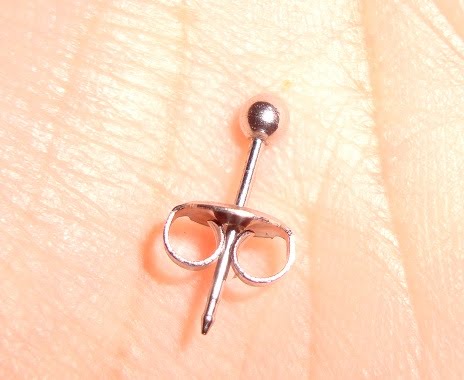 The reason you do this is that the earring you were pierced with was really only meant to be easy to use for the piercer, but not actually good for the healing process. As mentioned above, the jewelry needs to provide space for cleaning and a flow of fresh air. The short bar length and wide backing prevent both of these things. The bar is also sharp on the end since it is used like a needle, which can be uncomfortable behind your ear, especially when you sleep. A captive bead ring is easy to insert and able to be turned, which is very convenient for cleaning.
For cleanliness, the good piercers that I have known recommend plain liquid Dial soap. Really, any plain liquid antibacterial soap is good. Look for one with minimal dyes and perfumes. Simply water and soap up the captive bead ring and rotate it through the piercing. Rinse thoroughly with clean water and continue rotating until all the soap is gone and the ring is clean. Do this step twice a day or as needed.
Lubrication is the thing that most people don't seem to think about but it's very important to speed up the healing process. Take a dab of any kind of thin, clean, edible oil and rub it on your freshly cleaned ring, being sure to rotate it through so that the whole ring and the inside of the piercing are all sufficiently lubricated. I used coconut oil, but my friend used olive oil for hers. The reason for this is that a new piercing needs constant lubrication because new piercings are sticky. Your body is trying to grow new skin cells in the area that was punctured with the added irritation of a metal device (which should only be surgical stainless steel). When your skin gets stuck to the ring, it is painful to turn because you are essentially tearing at the area that is trying to heal. This makes for a greater potential for scarring and just makes the healing process longer and painful. A little oil solves that problem.
Just to mention, if your piercing is anywhere on your head, it is a good idea to keep your hair out of the way for awhile to prevent contamination and pulling.
I used this method for myself and recommended it to all my friends when they got new piercings. They all reported positive results. This is also a good method to encourage an already infected piercing to actually heal. However, if it becomes very painful and inflamed, you will probably have to squeeze puss out of it. Do not let it get to this point. If it does, you may have to go to a doctor and you may have to take it out.

